

Destinations
Experiences
|
L A
D A T C O T O U R
S |
|
||||||||
| HOME | South America | Falkland Islands | Antarctica | Unique Destinations |
Unique Experiences |
Newsstand | ||||
 |
Chan Chan Trujillo |
 |
 |
 |
 |
ABOUT CHAN CHAN - compliments of PromPeru:
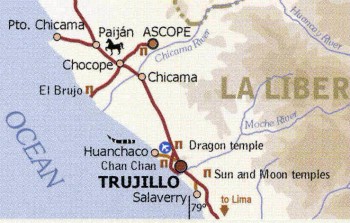
The ancient Chimú kingdom (700-1400 AD) founded their capital by the banks of the Moche River in the department of La Libertad and called it Jang-Jang, which in the ancient Mochica language means "sun-sun".
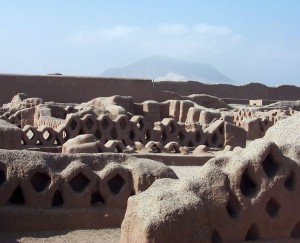
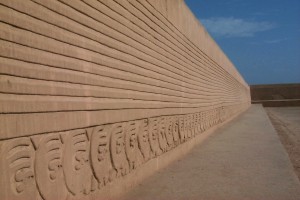
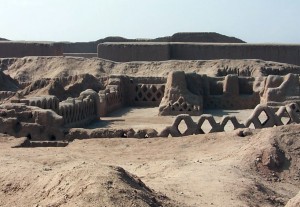
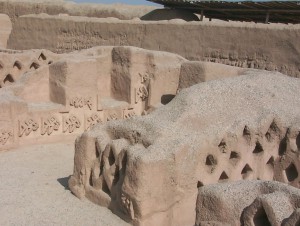
Chan Chan, which spans an area of 20 square km, is the largest mud-brick citadel dating back to the pre-Hispanic era. To build it, the Chimú architects used clay, mud, pebbles, wood, reeds, straw and cane, materials which enable the citadel to blend in with the sandy coasts. The complex is made up of many cities within a city, each of which has its own single entrance which leads down a corridor that opens up into other passageways lining walls and buildings featuring some marvelous rectangular architecture: inner patios, residences, administrative buildings, temples, platforms and storehouses. The walls were decorated with haut-relief friezes done in geometric and animal figures. The T-shaped platform that housed the king's burial chamber was the most important construction in the complex. The citadel was surrounded by outlying quarters which housed the kingdom's producers and servants. The separate cities today have been given the names of the archaeologists who studied them (Rivero, Tschudi, Bandelier, Uhle, Tello). The Rivero city was the seat of Minchancamán, the last of the Chimú rulers, who was captured by the Incas and taken to Cuzco, according to the Spanish chroniclers.
The city was the urban center of a vast regional state which covered half of the Peruvian coast, stretching from Tumbes on the Ecuadorian border down as far south as Lima. All roads branched out from Chan Chan.