


Destinations
Experiences
|
L A
D A T C O T O U R
S |
|
||||||||
| HOME | South America | Falkland Islands | Antarctica | Unique Destinations |
Unique Experiences |
Newsstand | ||||
 |
El Brujo Trujillo |
 |
 |
 |
 |
ABOUT El Brujo - compliments of InkaNatura:
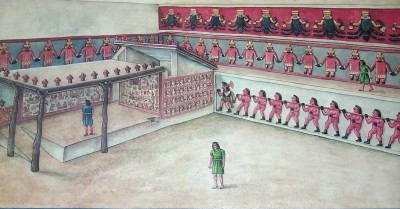
"Huaca Cao Viejo" is an archaeological site dating back to the Moche culture (100 BC-650 AD). It is a badly damaged, stepped pyramid with a central court that was probably used primarily for religious ceremonies. This pyramid is undoubtedly the most impressive Moche site in the Chicama Valley and is nowadays more often referred to as "EL BRUJO" ("The Sorcerer"). This current name is due to the common practice of shamens of the North coast (who also are called “brujos” or “curanderos”) to hold some of their healing ceremonies at prominent hills or prehispanic ruins, which they consider to be places of power.
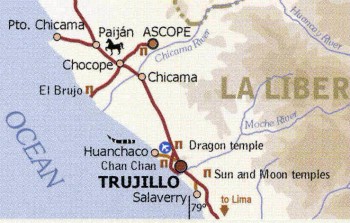
This huaca or "ancient place" lies very near the sea, close to the small fishing village Santiago de Cao, on the right hand margin of the Chicama River. In one of the most important Moche sites in this large valley of the north coast. This valley lies immediately north of the Moche valley that was the location of the presumptive capital of the Mochica polity, where we find the HUACA DEL SOL Y DE LA LUNA COMPLEX. Many more sites of the Moche culture are known in the lower and middle sections of the Chicama Valley, such as habitation structures and ceremonial platforms. One also can find major in the Chicama Valley major sections of a large and very complex prehispanic irrigation system, parts of which are still in operation today. This irrigation system may well date back to the Moche period.
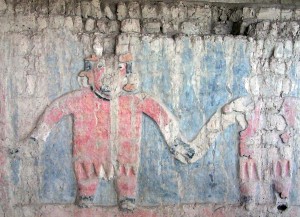
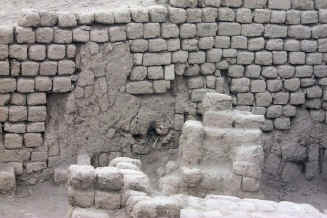
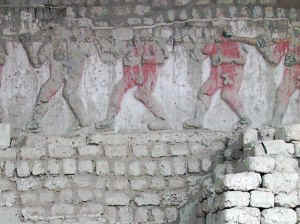
The currently-visible structure called EL BRUJO rises about 98 feet above the surrounding desert and covers an area of roughly 330 by 330 feet (Figure 4.1). Probably there are many simple wattle-and-daub structures still buried beneath the sand that surrounds this stepped, truncated pyramid, which itself was built with tens of thousands of adobe bricks. The dimensions measured today, however, must be seen as the product of at least seven building phases. During each of these phases, the central central building would have undergone extensive remodeling and expansion. The extraordinary, painted reliefs preserved at Huaca Cao Viejo owe their current excellent state of conservation not only to the extremely dry climate of the Pacific coast of Peru, but also to this tradition of building over the older structures.
The famous mural ornamentation was discovered accidentally by local "huaqueros" (grave looters), who reported the find in 1990 to a prominent Peruvian banker interested in archaeology. Since then, this philanthropically-minded banker has funded excavations and excellent research and conservation measures.