

!LTylo100.jpg (12810 bytes) L  A   D  A  T  C  O     T  O  U  R   S
Custom Designing moto web banner.jpg (9711 bytes)
!!!pacolor100.jpg (14505 bytes)
HOME South America Central America Falkland Islands Antarctica Unique
Destinations
Unique
Experiences
Newsstand e-mail

!!!!GPS Safari Camp baby sea lion.jpg (22343 bytes)

Galapagos Safari Camp
Sample Programs

Highlands, Santa Cruz Island
Galapagos Islands, Ecuador

Accommodations Sample Programs

!!!!GPS Safari Camp tortoise face.jpg (24368 bytes)


GPS Safari Camp map 2.jpg (86137 bytes)  

ABOUT ACTIVITIES AT GALAPAGOS SAFARI CAMP - in their own words:

On the farm you can spend time walking, bird watching and spotting visiting tortoises. The vegetation is lush and the terrain is volcanic so good walking shoes are required. There are a number of wonderful viewpoints from which to observe birds or simply relax.

The neighbouring area to the farm is known as the “highlands”, spanning fertile vegetation zones with a blend of agricultural land and national park. Attractions range from a tortoise reserve to lava tunnels and volcanic craters. Walking, cycling or horse trekking can be organised upon request.

The lowlands of Santa Cruz Island boast pristine turquoise waters and white sandy beaches. You can snorkel, dive, kayak, surf or just swim. The main town, Puerto Ayora, is vibrant and lively, with many restaurants, shops and galleries.

Further afield. For those wishing to visit other islands, a stay at the camp combined with an extended cruise provides the perfect solution. Alternatively we can help you organise snorkelling or diving to neighbouring islands.


SAMPLE SANTA CRUZ SAFARI PROGRAM

Day 1, Exploring the highlands
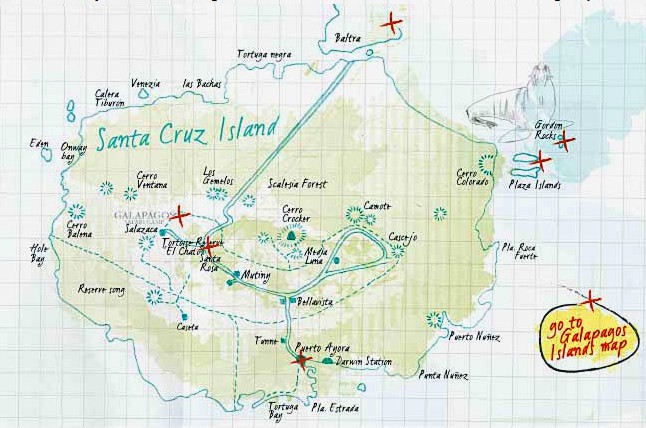
Flight to Baltra island where you will be met by your naturalist guide who will accompany you for lunch and a complete tour of the highlands. You will visit Los Gemelos, collapsed twin craters that were formed by a series of eruptions when the island was still active. This area is one of the few where the Scalesia forest is almost intact. Tortoises wander around, finches and vermilion fly catchers can also be seen. You will experiment total darkness and learn about the formation of these fascinating islands in the lava tunnels and your tour ends at GSC for a sunset drink & dinner

Day 2, Naturalist walk
The trail begins at the village of Bellavista and takes you to some of the biggest hills of the island: Media Luna, Puntudo and Cerro Crocker. The distance from Bellavista to Media Luna is 5 km and from there to Puntudo and Cerro Crocker close to 3 km. Ornithologists will thrive in this area as there are several bird species that can be observed such as rails, finches and petrels

Day 3, Discovering the East
Start the day by visiting an organic coffee farm; you then continue to Garrapatero, one of the most exotic and beautiful beaches in the Galapagos which offers a landscape of black lava with pioneer cacti, white sand and a turquoise sea. You can watch the blue-footed boobies and pelicans fishing in the bay, crabs scuttling into their burrows and marine iguanas strolling along the beach. There is a small lagoon behind the beach where bahama ducks and pink flamingos can often be seen

Day 4, Beach and relaxation
Spend the morning enjoying Tortuga Bay, a pristine white sandy beach which buzzes with wildlife. You can also stroll over to a tranquil mangrove lagoon ideal for swimming and snorkeling. Lunch in Puerto Ayora gives you a taste for town and you can then indulge with a body treatment at Chi Spa and/or an unguided tour of the Charles Darwin Foundation where visitors can see the tortoise breeding center

Day 5, Sunrise walk and departure
On your last day there is a tour of the farm at GSC where you can enjoy the sunrise from one of our view points and continue for a walk to the barn owl’s cave before breakfast and transfer to the airport

SAMPLE SCUBA DIVING PROGRAM

Day 1, Thursday - Flight to Baltra island and transfer to GSC. Lunch and complete highlands tour: Los Gemelos.- These collapsed twin craters were formed by a series of eruptions when the island was still active. This area in one of the few where the Scalesia forest is almost intact. Some finch species and vermilion fly catchers can also be seen. Giant Tortoises.- can be observed in the highlands of the island in their natural habitat. Tortoises wander around the few farms of the area. Ducks and gallinuelas are also found here. Lava Tunnels.- Experiment total darkness and learn about the formation of these fascinating islands.

Day 2, Friday - Seymour, 2 dives: North Seymour is an uplifted island of lava flow about 90 minutes north of the dive base. This sites has the most different species per square foot of sandy bottom. We can se cleaning behavior, a large garden eel colony, sea turtles, sea lions, fur seals, eagle rays, yellow-tailed grunts, big-eyed jack, and frequently white tip reef sharks and hammerheads.

Day 3, Saturday - Beagle, 2 dives: These are 3 exposed rocks located south of Santiago Island, about 1h30’s cruise from Itabaca channel. This beginner/intermediate dive site starts on a 12 meters deep platform and leads to a wall, covered with black coral and sea fans, that drops to more than 60 meters. Pelagic species that can be observed include hammerheads, Galapagos sharks, mantas during the hot season, small rays, turtles and sea lions.

Day 4, Sunday - Gordon, 2 dives: (minimum experience to participate at this site is 30 logged dives) This tuff cone formation is a world famous dive site about one hour from the base. This site is for intermediates and experts because there can be strong currents and surge. This is mainly a wall dive. Hammerhead sharks are the main attraction of Gordon Rocks, where they often conglomerate in large schools. Your likely to also see reef fish, large pelagic fish, golden rays, stingrays, eagle rays, turtles, morays.

Day 5, Monday - GSC checkout, transfer to Baltra airport and departure flightl