

Destinations
Experiences
|
L A
D A T C O T O U R
S |
|
||||||||
| HOME | South America | Falkland Islands | Antarctica | Unique Destinations |
Unique Experiences |
Newsstand | ||||
|
Finch Bay Eco Hotel Puerto Ayora, Galapagos Island Scuba Diving - Why |
|
 |
 |
 |
 |
FINCH BAY ECO HOTEL "WHY DIVE THE GALAPAGOS" - in their own words:
Scuba Diving:
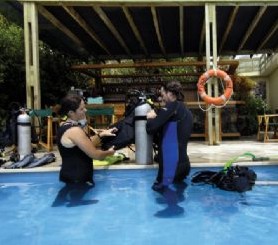
FBH offers a PADI designed program to allow guests to experience the thrill of scuba diving in a safe and fun environment. A PADI certified instructional diver provides approximately 1 hour of theory and verbal instruction.
Immediately following the classroom instruction, guests will don wet suits and tanks for 2 hours training in the Hotel swimming pool. Once guests are comfortable with the basics in the swimming pool, they are on their way to a shallow water ocean immersion lasting approximately 40 minutes. This program is available to all guests ages 10 and above.
Why Scuba Diving?
Since the first man ever entered the water, its life changed forever. More so now, as knowledge, science, exploration and conservation, all team together to enhance the beauty of our different bodies of water. The ocean, thus far, the largest body of water, is a world to be discovered. Many already swim and snorkel, but there’s nothing more exciting than to be able to breathe underwater and see the wonders of this aquatic realm. Scuba diving is an exciting adventure, filled with emotion, pride, accomplishment, and most of all, a fun activity. There’s never been a better time to scuba dive than now. Come with us and take the plunge!
Why Scuba Diving in the Galápagos Islands?
The Galápagos Islands are a group of 13 major islands, and some 45 islets, all volcanic in origin, and all bathed by ocean currents as diverse as the wildlife that inhabits this Natural Heritage for Mankind. These currents are responsible for the unusual weather pattern of this tropical jewel, where penguins live next to parrot fishes, and hammerhead sharks live next to marine iguanas. Such diversity has given the islands the status of Marine Reserve, where 130,000 Km2 are protected by law. This makes Galápagos, the Earth’s second-largest Marine Reserve, and the largest of all within America.
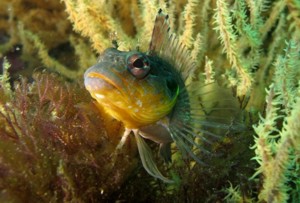
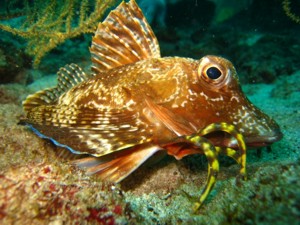
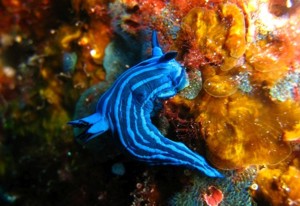
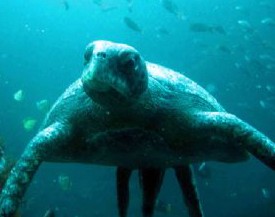
Galápagos is famous for its encounters with “the big animals”, and not only for its crystal-clear waters or numerous colorful reef fishes. Many well-respected industry magazines list the islands as the World’s Best Diving. Fortunately, not many divers come here, and thus, diving is not geared for crowds. It is, by all means, very selective and quite personal. This adds a unique value to the overall adventure. Some of the underwater encounters, to name a few, include rays, angel fishes, sea lions, parrot fishes, hammerhead sharks, sea turtles, jacks, eels, groupers, scorpion fish, reef sharks, and the always attractive invertebrates that make pelagic islands a world to be discovered. There are about 385 species of fish, and about 20% are only found here. In addition, divers are interested in interacting with the unique wildlife found on land, and the opportunity of admiring this Natural Heritage. Diving here is quite rewarding, and before the voyage ends, most already think about coming back. Where else have you experienced that?
Why Scuba Diving in the Galápagos Islands at Finch Bay Hotel?
Until now, most diving has featured live-aboard diving. And by all means, the diving will be quite amazing, and certainly rewarding. Since 2003, a new operation based on Santa Cruz Island was launched, as the greatest addition to the scuba diving options available. Finch Bay Hotel offers the best accommodations available, white-coral beach access (the only hotel in Santa Cruz Island right at the beach), multisport activities, air conditioned rooms, and outstanding service. Island cuisine with local and international flavors will add to anyone’s stay.
Finch Bay has joined efforts with Subaqua, the most successful local dive operator, for its scuba diving programs. Subaqua’s experience rates high in critical areas such as safety, service, knowledge, equipment and support. Their day-trip dive boats will allow divers to reach dive sites efficiently, and while on board, divers receive full details regarding dive conditions, share the diving experience, and of course, camaraderie will be top notch. Subaqua is a PADI-registered facility, and part of the PADI Travel Network.What is like to Scuba Dive in the Galápagos Islands?
Weather seasons
Although the islands are tropical, there are two markedly different seasons : the warm, humid and sunny season from December to May and the dry, windy and not-so-sunny season from June to November. Transitional months are January, April and May. The Warm Season offers hardly any wind (so the sea is usually very calm) and the visibility tends to be better. In the Dry Season there is more wind, sometimes the sea tends to be choppy and the visibility lower.
Water temperature
Surprisingly, its water temperatures range from 16°C to 27°C degrees Celsius (61°F – 80°F); we use full wet (6mm) suits all year around and hoods in the cold season. Regardless season, a thermocline is commonly found below 12-15 meters (37-45 feet)
Visibility
In general, visibility ranges from 5 to 25 meters (16 to 82 feet), but most of the time it is restricted to between 12 and 18m. A large submarine current (Equatorial Undercurrent) coming from the West Pacific hits the largest island of the archipelago (Isabela Island) and is deflected upward reaching the surface, bringing up the cold and nutrient rich water; this can change the water temperature by as much as 6 degrees Celsius, and change the visibility in a matter of one or two days. It is this unique feature, however, that brings such unpredictable marine life.
Experience for Galápagos Diving
* Beginners: Newly certified divers or divers with few dives logged (3 to 15 dives).
* Intermediate: 15 to 50 dives logged with experience in cold water and with drift and wall diving.
* Advanced: 100 dives or more logged with experience in cold water and with drift and wall diving.
Detailed description of dive experience is always necessary to confirm a dive program, because a diver with 10 dives in cold water and currents may feel a lot more comfortable than a diver with 40 logged dives in warm water and little current - also a newly certified diver may feel more comfortable than a diver with 50 logged dives but who has not been diving for 6 years.
Our Diving
We have great dive sites for beginners, intermediate and experienced divers, although the best dive sites are usually the most difficult ones, with significant to strong currents near vertical walls. Most of our diving is drift diving, so the Dive Masters skills play an important role. Beginners can start at the easier places and proceed to the more difficult ones always led by our Dive Masters or instructors. In all our dives our Dive Masters will be actually diving in the water with guests. Another important aspect of the Dive Masters skills is that, although there is a decompression chamber on the islands, the Dive Masters duty is to guarantee that, to a reasonable extent, everybody is on the safe side.
The Dives
Each dive is one tank. We use aluminum tanks with 3000 psi /207 bar - all tanks have the international connection system - if passengers want to use their own regulator with DIN system they have to bring their own adapter. The bottom time depends on each passengers air consumption. All dives are in-between 15 and 25 meters because this is where you encounter most of the marine life in the Galápagos. Maximum depth for our dives is 30 meters.
Equipment
Our daily dive trip rates always include complete SCUBA gear. Diver can decide whether they want to use our equipment or bring their own.
Where and when
All day trips leaves from Pto. Ayora, Santa Cruz Island. We normally depart around 8:30 AM and, depending on the navigation distance to each site, we will come back approximately at 4:30 PM.
What is included
Full SCUBA gear (full 6 mm wetsuit, jacket type BCD with power inflators, regulator with octopus, pressure gauge and depth gauge, mask, snorkel, fins and booties) , 2 boat dives in small groups, Dive Master diving in the water with guests (max. Dive Master to diver ratio 1:6), transfers to/from Puerto Ayora and dive sites, drinking water, basic snacks. Our programs outside the Academy Bay also include box lunch.
Information required before confirming a daily diving tour
Safety comes first and therefore we require the following information about each guest’s dive experience in order to make the program that fits with your skills and interests:
1. What type of divers license (level and training agency)
2. How many dives
3. Date of last dive
4. Experience with drift and wall diving
5. Experience with diving in cold water and with 6mm wet suit
6. What would the customer like to see in the Galápagos
With this information we can put together the program and the customer is off to experience one of the most fantastic dive adventures.
Open Water Certification
Our facility is also capable of offering your passport to the enjoyment of diving. Become fully certified in the Galápagos Islands and receive the best training, next to the healthiest marine life of this planet. Detailed theory, pool work and first open water dives included. The internationally-recognized PADI certification card never expires. Open Water Certification: Request rates.
Continuous Education
For the diving enthusiast, Galápagos is the greatest location to continue pursuing your diving career. Due to the islands’ unique conditions, training not only happens under natural circumstances, but the encounters with marine wildlife are just endless. These courses help divers learn new skills while pursuing individual interests. Specialty Courses currently offered:
* Advanced Diver: Request rate
* Rescue Diver: Request rate
* Dive Master: Request rate
* EFR: URequest rate
Discover Scuba Diving
PADI’s addition to the underwater options can show the non-diver (yet!) the amazing world of underwater discovery. This introduction to scuba diving invites participants to learn the basics about diving, both in theory, practice, and pool work, to ultimately enter the waters of the Galápagos. Starting age is 10 years, and a minimum of 3 participants is required. Chances are you will want to become a scuba diver right away. Request rate.