
|
|||||||||||||||||||||||
![]() |
ECUADORIAN
RAINFOREST Napo
Wildlife Center |
| GO TO |
| About Rainforests | Rainforest Basics | Rainforest Experiences |
|
About
the Conservation project - in their own words: The Napo Wildlife Center is the only lodge on the south bank of the Napo, which harbors 30% more bird and animal species than the north bank. With parrott licks, GIant Otters, Woolly Monkeys and ten other primates, Napo WIldlife Center is the finest wildlife destination in the Amazon of Ecuador. W visit to the comfortable Napo Wildlife Center is an unforgettable experience that directly protects both the community's reserve and Yasuni National Park. |
![]() |
![]() |
![]() |
![]() |
ABOUT THE NAPO WILDLIFE CENTER - in their own words:
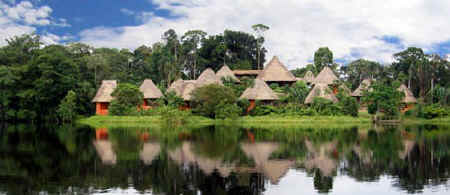
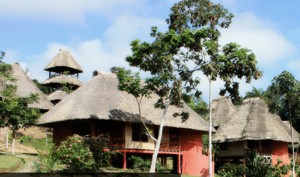
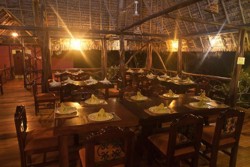
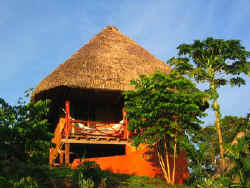
The lodge consists of 10 luxury cabañas and a large dining hall with a library and a well-stocked bar. Attached to the bar is a 50-foot viewing tower from which you can see the Andes on a clear day!
The rooms are huge (6x7 meters!), always clean, and include:
one king-sized bed and one twin-sized bed (up to 3 people)
private bathrooms with on-demand hot water
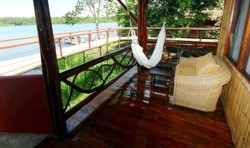
private porches with lake views
24-hour electricity with plenty of lights and plenty of 120v outlets
ceiling fans and secure screens for plenty of bug-free ventilationThe food is excellent right down to the fresh-baked bread and local fruit.
The lodge itself is beautiful, nearby blinds built at parrot clay licks bring the action to you, and the natural attractions are simply unmatched in Amazonian Ecuador.Monkeys, Parrots, and Giant Otters during the day, with the comfort of a hot shower, big dinner, and a cold beer at the end of the day. This is just what you have been looking for....
DINING ROOM TOWER: There is a 60 ft tall observation tower on top of a 42 foot hill, high enough to have great views of the lake and lodge.
| GETTING THERE:
From Quito 35 minute flight over the snow capped volcanoes to Puerto Francisco de
Orellana, locally know as Coca. Planes are the 19-seater JetProp Beechcraft 1900-D
Air-liner and the 69 passengers Fokker MK-4000 Fellowship. Crafts and pilots are
FAA-certified in the US. At Coca the staff from the Napo Wildlife Center will meet and transfer you 5 to 7 minutes to the river where you embark on covered motorized canoe for approximately 2 hours ride (50 miles) downstream on the Napo River. During this trip a good number of birds can be spotted, including herons, kingfishers, ospreys among many others. The boat will arrive at the northwest boundary of the Yasuni Biosphere Reserve, where NWC is located by the Anangucocha Lake. To access the lodge you may either take a guided 2 1/2 km (1 1.2 miles) hike with rich forest wildlife, or embark on a quiet and enjoyable paddle dugout canoe ride for 1 1/2 hours along a creek with dense flooded palm forest. On either route it is possible to see several species of monkeys, colorful birds and other potential wildlife. At the end of the walk and near the end of the paddle, there is a superbe view of the lodge across Anangu Lake. NOTE: There is a luggage weight limit of 20kg per person plus a carry-on such as hand luggage with reading material, camera, binoculars and personal documents. Additional or excess baggage is charged directly by the airline by pound. ENTRY-EXIT DAYS: Entry or exit can be Monday or Friday - thereby allowing a Friday to Monday 3-night program and a Monday to Friday 4-night program. For additional cost, it is possible to arrive or depart any day except Sunday. |
| ACTIVITES: (Note: rain ponchos and boots are provided when
needed for excursions, in standard sizes) PROFESSIONAL CANOPY TOWER: Only 35 minutes away from the lodge is the best and most professional canopy tower ever built in the Ecuadorian Amazon. It is 125 feet tall, standing right next to a giant 155 Kapok tree with an ample platform provides space for 15 guests. It is possible to spot troppos of howler, capuchins, monk sakis or spider monkeys in the nearest forest. Active feeding bird flocks reach this area - 80 species were sighted in one single morning. LAKES & CREEKS: NWC has a large lake with two creeks that can easily be explored, with possibilities to see squirrel, saddlebacked and white fronted capuchin monkeys. NWC has 11 species of monkeys, four species of cayman and a group of giant otters. FOREST TRAILS & HIKES: Hikes along a variety of forest types are possible by visiting different trails. On forest trails you can see monkeys, lizards, tortoises, frogs and army ants in addition to an array of birds, including toucans, parrots, manakins and hummingbirds. BIRDWATCHING: Over 562 species of birds have been recorded at Napo Wildlife Center, more than 1/3 of all of Ecuador's species.Agami and ZigZag herons are found near the lake and creeks, including all five kingfishers. THe large raptors like Harpy and Crested Eagles find healthy mammal food around the area. The active calls of forest floor mixed species flocks with the largest number of the surprising antbirds can be found. Canopy flocks are normal to run into, helped with the expertise of the top native birdguide along the entire Napo: Jiovanny Rivadeneira. THE ANANGU COMMUNITY: Anangu is not only home to the NWC lodge. It has been the ancestral territory of a Quichua indigenous community that has the same name. Anangu pople are active participants of the conservation and management of a larte territory within the park as well as the lodge's partners in tourism. You can join some families on their daily activities when harvesting bananas, coco and manioc, or maybe help prepare chicha, a traditional drink based on cokked and fermenting manioc. |
|
PARROT BLINDS AT THE
NAPO WILDLIFE CENTER: We have constructed
blinds at two of the clay licks of the Napo Wildlife Center Reserve Area the most
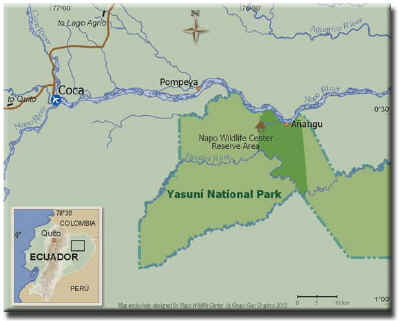
accessible parrot and macaw clay licks in Ecuador (map). Visiting these clay licks helps
to support an 82-square-mile private reserve and also supports Yasuní National Park,
which is a UNESCO Biosphere Reserve. |
Saladero de Loros:
The blind nearest the Napo (Saladero de Loros) is typically visited by hundreds of
individuals of Mealy Parrot, Yellow-crowned Parrot, Orange-winged Parrot, Blue-headed
Parrot, Dusky-headed Parakeet, and an occasional White-eyed Parrot or Cobalt-winged
Parakeet. The blind at this site is huge, with plenty of space for upwards of 30 guests at
a time, and even includes a basic bathroom. Access is a simple 50m walk on a stable and
slip-proof boardwalk.
Saladero de Pericos:
The blind in the forest (Saladero de Pericos) is typically visited by a thousand or more
Cobalt-winged Parakeets. The noise is incredible! From late October through early April,
hundreds of Orange-cheeked Parrots are also found in the mix, as are rarities such as the
Scarlet-shouldered Parrotlet and occasional Scarlet and Red-and-Green macaws. It is almost
certain that other small parakeets visit this clay lick, and new species for the region
and Ecuador are just waiting to be discovered. [This is the site incorrectly listed as
"La Selva" and "interior salado at La Selva" in The Birds of Ecuador
(Ridgely and Greenfield, 2001)]. Access to this clay lick involves a 700m hike on an
improved path with stairs and boardwalks where necessary. The blind itself will hold
upwards of 20 guests and affords fantastic views. Birdwatchers will note that this is
where one can find the famous "Manakin Trail" with 6 species of manakins.