

|
|||||||||||||||||||||||
|
Pantanal Brazil's undiscovered wilderness introduction provided
by |
|
The Pantanal, considered to be the world`s
biggest wetland area, covers an area of approximately 150,000 km² situated in the upper
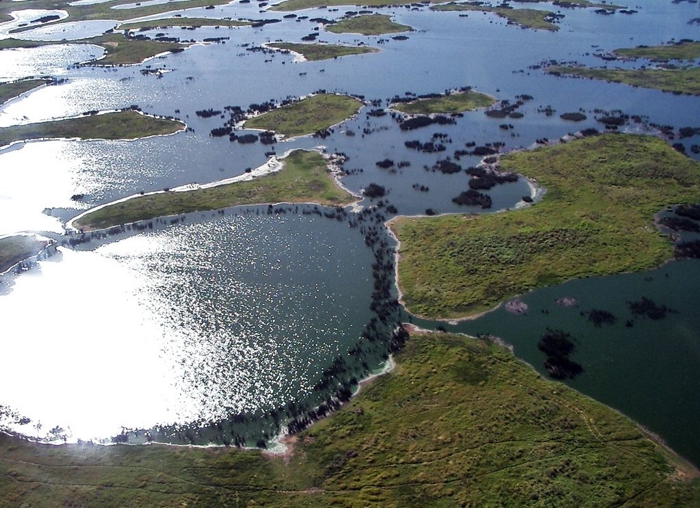
Paraguay River Basin. The greater part lies in Brasil, divided between the states of Mato Grosso and Mato Grosso do Sul, extending into Bolivia and Paraguay. The Pantanal, with an elevation of between 80-150 meters is surrounded by higher plateaus and this is where the Pantanal river system springs from. When the Portuguese discovered the basin they actually took it for a permanent inland sea and on the oldest maps of South America the area is named "Sea of Xaraés". Only a bit more than 200 years ago the first Portuguese settled down in the region and gave it the name it has today: "O Pantanal", which in Portuguese means "The Swamp". The Pantanal is not a real swamp though; it's a floodplain. Every year during the wet season, November to April, up to 2/3 of the whole area gets inundated by the complex river system. The annual rainfall in the Pantanal is between 1,000 1,400 mm, which compared to the Amazon isn't a lot. But the slope of the Pantanal is extremely slight: only 2 cm/ km in a north-south direction and the rivers are not able to cope with the rain water and overflow their banks. During this season only islands and forests on higher elevations remain dry. After the wet season comes dry season. The floodplain drains into the Paraguay river, part of the second longest river system in South America and life vein in the Pantanal and very slowly the wet lands turn into dry grasslands. As a result of the rain there is a huge flood wave that moves through the Pantanal. It takes this wave six months to go from the north to the south of the Pantanal. So in the south, a couple of months after the end of the rainy season, all of a sudden the water level rises again and the savanna gets flooded once more for a while. By the end of the dry season only a few spots of water are left and this is when you get the famous congregations of wildlife in the Pantanal. |
The Pantanal is noteworthy for its extraordinary bio diversity and abundance of wildlife and is known as "the world's biggest ecological sanctuary".
The vegetation of the Pantanal is mainly a mixture between three of the most important Eco-systems of South America; the Chaco with its dry forest formations to the south, the savanna-like Cerrado to the east and the Amazon jungle to the north. As a result of the topography and the seasonal climate the landscapes consist of swamps, seasonally flooded grass and woodlands, and various types of forest (evergreen, semi deciduous, gallery etc.). This mixture has caused the Pantanal to house the highest concentration of wildlife in all of the Americas.
In the Pantanal region occur around 700 species of birds (compared to about 500 in all Europe). It is one of the most important breeding grounds for typical wetland birds such as heron, stork, ibis and pink spoonbill that are found in enormous flocks. The magnificent Jabiru with its red neck and black head; the biggest stork of the Americas is known as the symbol of the Pantanal. Quite evident are also the 26 species of parrot including the endangered blue hyacinth macaw, the world's largest parrot more than one meter long. Of other characteristic birds can be mentioned the rhea the South American version of the ostrich. The large quantity of birds of prey represented by 45 species indicates a well balanced ecosystem.
The Pantanal is also one of the last refuges for many threatened South American mammal species such as jaguar, puma, ocelot, manned wolf, giant otter, giant anteater, giant armadillo, marsh deer (the biggest deer of South America), peccary (the south American wild pig) and tapir. The most characteristic mammal of the Pantanal is the capybara (the world's largest rodent up to 70 kg), that can be observed during the dry season in herds of up to 100 individuals. Monkeys are represented by 5 species.
Most evident among the around 50 species of reptiles are the Paraguayan caiman which is still quite abundant despite heavy poaching in the past and the world's largest snake the anaconda.
The many rivers and lakes of the Pantanal sustain a varied fish life of at least 260 species including several species of piranha as well as catfish of up to 120 kg.
Almost 99% of the Pantanal is privately owned land consisting of "fazendas", large cattle ranches. No cities are found in the Pantanal, only about 2,500 fazendas. In recent years the grasslands have fed up to 8 million head of cattle. Little of the area has been unaffected by the cattle and the activities of the local "Pantaneiros", but it is generally considered that these factors have left the nature relatively unharmed.
During the last decades, however, the Pantanal has been under serious attack. The area and its wildlife are threatened by a number of human activities such as poaching aimed at the international skin and pet trade, deforestation, man-made fires, illegal over fishing and uncontrolled tourism. The biggest thread in the long run, however, is the environmental contamination coming from the surrounding highlands where most of the population and activities in the region are found. Via rivers the Pantanal receives from these uplands substantial amounts of chemicals from agriculture, mercury from gold mining, untreated sewage and waste from cities and organic waste with high oxygen demand from various agro industries.
The Brazilians have a saying: "o Pantanal é vida" "the Pantanal is life". If this unique and precious life is to be saved the Pantanal needs a lot of help.
Suggestion for further
reading:
Vic Banks, "The Pantanal Brazil's forgotten wilderness", Sierra
Club Books 1992
WHEN TO VISIT:
- WET SEASON - December through March:
Due to intense rain the Pantanal gets flooded. The vegetation is exhuberant and humidity is high. Mammals seek refuge on higher grounds formed by tall trees, which are locally known as "Cordilheiras". This is the nesting time for many species of birds.- INTERMEDIATE SEASON - April through June and October through November:
In April the wter levels begin to recede and fish get trapped in ponds and small lakes, attracting thousands of birds. The peak of the dry season is October when the Pantanal resembles a dry African Savannah.- DRY SEASON - July through September:
This is the very best time for wildlife observation because wildlife gathers around watering holes. Dry fields make for good grazing areas, bringing wildlife out into the open. From August on most of the trees are blooming. Migratory species are in residence and nesting.